

Late October is when a lot of contractors feel best about cash. The busy season billed well, the account looks healthy, and the holidays still feel far off. Then January shows up with a full payroll, an insurance renewal, and very little coming in.
The bank balance didn't warn you because it can't. It tells you what you have today, not what you'll have on the Friday payroll hits six weeks from now. That's what a 90-day cash flow forecast is for.
Why your balance looks better than it is
Construction cash doesn't move in a steady stream. It comes in lumps, a draw here, a deposit there, and it goes out the same way, with materials and permits paid weeks before the first invoice on a new job. A snapshot of the account in the middle of all that tells you very little about where you're headed.
Most contractors are also running thinner than they realize. The median small construction business holds about 20 days of cash, meaning if billings stopped, the account would cover roughly three weeks of normal bills. Three weeks is not much room when a client pushes a draw past the holidays.
Why November through January is the stretch to watch
The next 90 days stack up against you in a few predictable ways:
Billings slow down. Inspections get pushed, clients travel, and draws that were due in December land in January.
Fixed costs don't. Payroll, rent, truck payments, insurance, and software keep running at the same pace through every holiday.
New jobs cost money first. Anything starting in January needs materials, deposits, and permits paid before the first draw comes in.
Year-end bills arrive. Insurance renewals, year-end accounting fees, and, if you pay quarterly estimated taxes, the fourth payment due in mid-January.
None of these are surprises on their own. The trouble is they all land in the same window.
The Number: $85,000 today, $26,000 short in January
Here's a typical remodeler heading into the holidays. They have $85,000 in the bank at the end of October, which feels comfortable. Fixed costs (crew and office payroll, insurance, rent, and trucks) run about $62,000 a month.
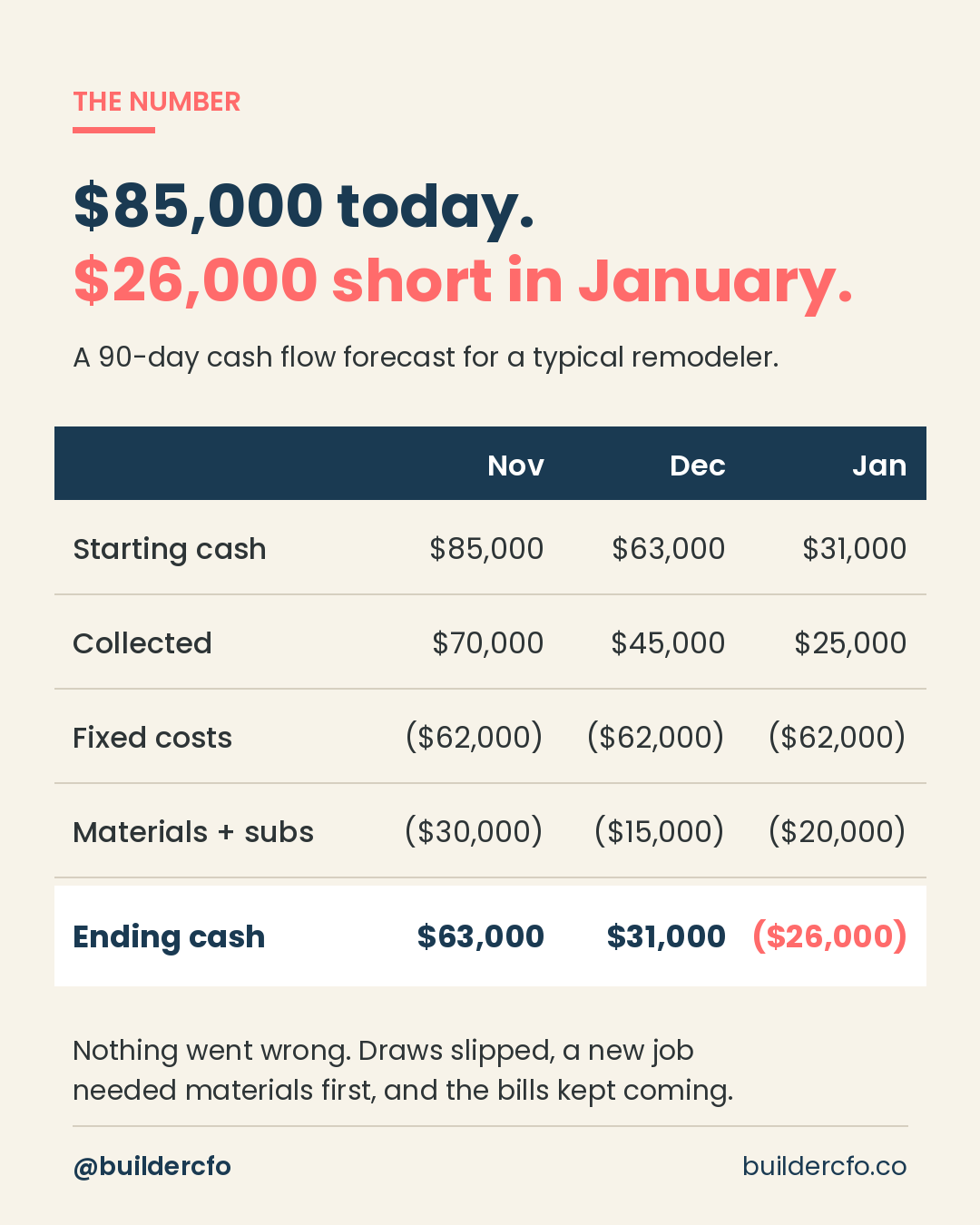
Nothing went wrong in this example. No client stiffed them, and no job lost money. December's draws slipped, January's new kitchen needed cabinets ordered before the deposit cleared, and the fixed costs kept coming. The business is $26,000 short by the end of January, and it would have found out on a Thursday afternoon when payroll didn't clear.
Spot that gap in October and it's a planning problem. Find it in January and it's an emergency.
How to build a 90-day cash flow forecast in about an hour
You don't need new software for this. A spreadsheet with 13 columns, one for each week, does the job. Work by week, not by month, because payroll is weekly and a monthly view hides your worst Friday.
Start with today's cash. The real balance in the operating account, minus anything already promised to a sub or supplier.
List every fixed cost by the week it hits. Payroll, rent, loan and truck payments, insurance, software, and your own draw.
List the money you'll actually collect, on the date it'll actually land. Not the date you invoice. If a client usually pays 20 days after a draw request, put it 20 days out. If December draws tend to slip, put them in January.
Add job costs by when you'll pay them. Materials, subs, permits, and equipment rentals for every active and upcoming job.
Subtract week by week and find your lowest point. That week is the one to plan around.
What to do when you see the gap
Once the low point is on paper, you have options you won't have in a crunch:
Bill on time, every time. Send December draw requests the day the milestone is hit, and follow up on anything past due before the holidays start.
Ask for real deposits on new work. A January job should fund its own materials, not borrow from payroll.
Time your material buys. Order what you need when you need it, and use supplier terms where you have them.
Line up a credit line now. Banks lend to a business with a forecast and a plan. They're much less eager to lend to one that needs money by Friday.
Adjust your own draw. A smaller owner draw in November and December is a lot easier than a missed payroll in January.
Keep it rolling
A forecast built once and filed away goes stale in a week. Spend 15 minutes every Monday updating actual cash, moving any collections that slipped, and adding a new week on the end, so you always see 13 weeks ahead. After a few weeks it stops feeling like a project and starts feeling like checking the weather.
If you'd rather have someone build it and keep it current with you, that's part of what Builder CFO does every month for contractors. Book a 15-minute call and we'll look at your next 90 days together.